
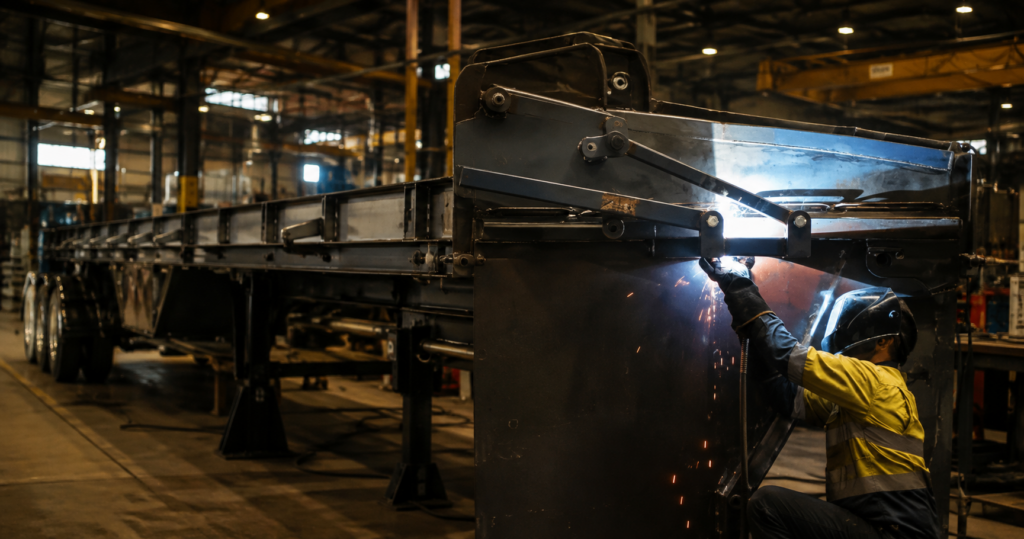
Ordering a new fleet of trailers is one of the biggest calls you'll make for your operation this year, and it's not one you get to undo easily. Before you sign anything, it pays to look past the price sheet and vet the business behind the build, whether that's a large importer or an Australian-owned manufacturer like Bruce Rock Engineering. So what should you actually check before that order goes in, and how do you compare one builder against another without getting lost in sales talk?
1. Start with the steel and the tare weight claims
Every manufacturer will tell you their trailers are strong. Ask what steel they actually use, because the answer changes everything downstream. Premium grades such as Hardox and Strenx let a builder cut tare weight without cutting strength, so every kilogram saved on the chassis becomes a kilogram of extra payload you can carry, load after load. A lighter, stronger trailer isn't a slogan on a brochure, it's basic physics, and it compounds over the life of a fleet. When a sales rep quotes a tare weight, ask what steel grade sits behind it and how they arrived at that figure. If they can't explain the specification, take that as your answer.
2. Find out whether the build actually happens in-house
Plenty of trailers sold in Australia are designed here but built somewhere else, or assembled from imported components under a local badge. Neither is automatically a problem, but you need to know which one you're buying, because it changes who you call when something goes wrong. A manufacturer with full in-house manufacturing controls its own welding, steel handling, and finishing from start to finish, so quality issues get caught before the trailer leaves the yard, not after it's loaded on a job. Ask directly where the chassis is fabricated and where final assembly happens. A supplier confident in their own process will answer without hesitation.
3. Check what happens after the sale, not just during it
A trailer is a long-term asset, so the sale is really just the start of the relationship. Ask about parts availability before you actually need a part, because that's when you'll find out whether the answer is a phone call or a long wait. Manufacturers running their own services and parts division, with genuine parts on hand and repair capability under the same roof, keep your trailers earning instead of sitting in a queue at someone else's workshop. This matters even more for agriculture and mining operators, where a trailer down during harvest or a haul campaign costs more than the repair itself. Ask how refurbishments are handled, and whether that work stays in-house.
4. Weigh lead times against your own operating calendar
A trailer that arrives after your harvest or your project mobilisation isn't much use, no matter how well it's built. Lead times vary widely across the industry, so ask for a realistic build and delivery timeframe early, before you factor a new trailer into next season's plans. Then ask what happens if that timeframe slips, because it occasionally will, and how the manufacturer communicates delays matters as much as the delay itself. A builder with in-house manufacturing generally has more control over its own schedule than one waiting on an overseas supply chain feeding parts in. That control is worth asking about directly.
5. Confirm the compliance paperwork actually stacks up
Compliance isn't optional, and it isn't really negotiable either. Confirm the trailer meets the relevant ADR standards for its class, and if you're planning modifications down the track, check the builder holds VSB6 certification to carry them out properly. This becomes critical for PBS-approved combinations, where the trailer, the combination, and the route all need to align, so ask whether the manufacturer has runs on the board with PBS-approved builds specifically. A manufacturer that treats compliance as a formality is one to be wary of, in my view, because it's the part of the build that keeps your drivers and your business protected.
6. Read the warranty like a contract, not a brochure
A warranty is only as good as what it actually covers, so read it properly rather than taking the headline period at face value. Ask what's included, what's excluded, and whether cover changes if the trailer works in a harsher environment like a mine site or a quarry. Then ask how claims are handled in practice, because a warranty that requires the trailer to travel interstate for assessment isn't much of a warranty at all. Finally, look at the manufacturer's track record with operators in your own industry, whether that's agriculture, mining, construction, or general freight, because a builder that already understands your loads will design for them rather than making you explain it first.
7. Bring the comparison back to your own operation
Once you've asked these questions of every manufacturer on your shortlist, the comparison gets much easier. Line up the steel and tare weight claims, the in-house capability, the parts and service support, the lead times, the compliance record, and the warranty terms side by side, and the gaps between suppliers become obvious fast. A fleet order is too big a commitment to base on a glossy spec sheet alone, so talk to the team behind any manufacturer you're considering and ask them to walk through a configuration that matches your actual work, not a generic model off the shelf. The builder willing to have that conversation properly is usually the one worth ordering from.