
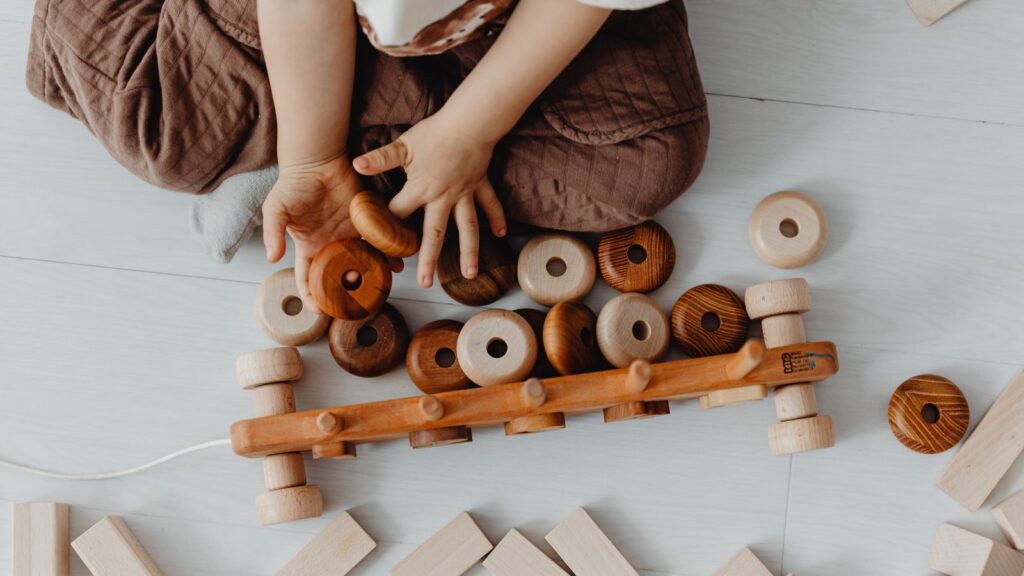
A child who chews shirt cuffs, presses their back hard into the sofa and hums through every quiet moment is not being difficult. Each of those habits points at a different sensory system, and each one is a request for a particular kind of input. Shopping for sensory toys goes better when it starts there instead of at the display bin: work out what the child keeps going after, then buy for that. Once you can name the input—resistance, texture, movement or quiet—you can compare toys for sensory development with a clearer purpose.
Skip that step and you pay twice, once for a well-made toy and again for the shelf it sits on unused.
Three of the inputs adults overlook are the ones nobody can see. Proprioception is the sense of where the body is and how hard it is working, and it is fed by pulling, carrying, pushing and squeezing. The vestibular system reads movement and head position, and it is fed by swinging, rocking and spinning. Touch, the sense everyone reaches for first, is only the third of them.
Sensory Toys for Toddlers: Start With the Hands and the Mouth
Under three, the mouth is a research instrument, so construction matters more than the feature list on the box. Sensory toys for toddlers live or die on seams, glued caps, sewn-in beads and anything that can be worked loose by a determined molar. A single piece of molded silicone or rubber holds up where a stitched fabric ball with a bell inside does not. Texture is worth varying deliberately, because ridged, pebbled, smooth and soft feel like four separate things to a hand that is still building a vocabulary for them. Weight is the second variable and the one most shopping guides miss, since a toddler who wants heavy work will not be satisfied by anything light, no matter how interesting its surface.
The rule of thumb worth keeping is blunt: if a part can be squashed small enough to pass through a toilet-roll tube, it is not for this age.
Supervised bins of dry rice, lentils or oats give more play per dollar than most molded toys, provided an adult is at the table. Scoops, funnels and a tray deep enough to catch spills turn the same bin into pouring practice, which is where fine motor work quietly begins.
- One-piece construction. Fewer joins mean fewer failure points, and for a child who mouths everything a molded shape is safer than a stitched one with a filling inside.
- Easy cleaning. Toddler play is wet play, so anything that cannot go in the sink or the top rack of a dishwasher will be quietly retired within a month.
- A single clear input. A rattle that also lights up, vibrates and plays a tune asks the child to filter three channels at once, which is the opposite of what a child seeking one kind of input needs.
Sensory Toys Canada: Building for the Indoor Half of the Year
For much of the country the outdoor half of a child’s sensory routine closes down around November and does not reliably reopen until April. Winter changes the practical question for families: what can a child use in a living room when outdoor play is limited? Indoor heavy work is mostly furniture and floor: a weighted lap pad during a story, a cushion pile to crash into, a stretchy tunnel to push through.
Cold-weather layers change the tactile picture as well. Mittens and snowsuits mute nearly all fine touch, which is why a child who was settled outdoors in October can come in from an hour of January play unsettled and still hunting for something to feel.
Substituting by input rather than by product keeps the shopping list short. A compact balance board, a rocking toy or a swing rated for indoor mounting covers the movement the backyard supplied in summer. Heavy work needs nothing specialized at all, since laundry baskets, grocery bags and a weighted ball already do it. Warm water at the sink, kinetic sand on a tray and dough at the table stand in for the mud, grass and sand that are under snow until spring.
That last trio costs less than one light-up toy and gets used more.
Sensory Toys for Kids: What Works Once School Starts
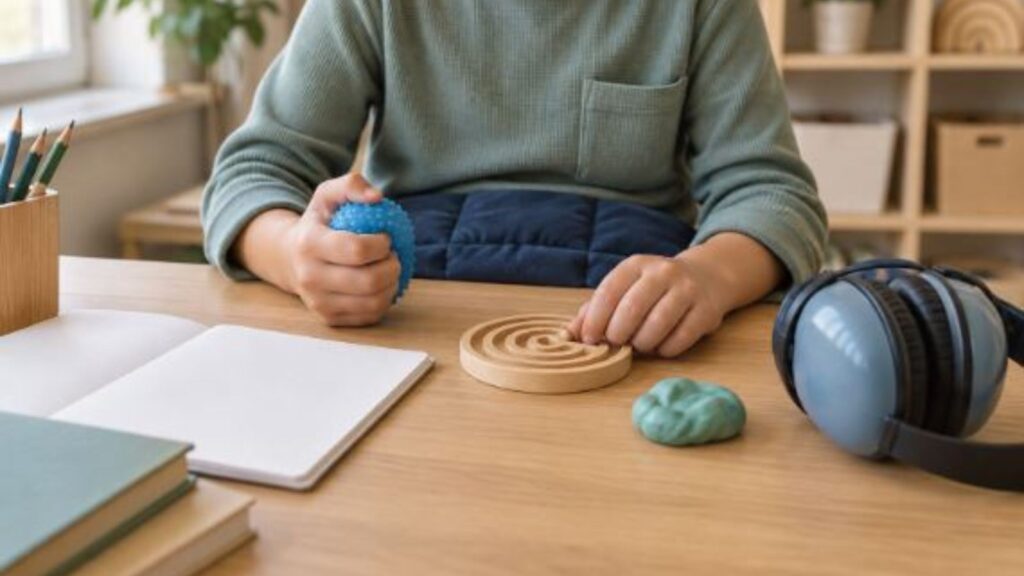
School changes the constraint from what a child needs to what a room can tolerate. Sensory toys for kids in a classroom have to be silent, small enough to stay under a desk and dull enough that the child at the next table does not want a turn. That last criterion is the one adults get wrong most often, because a fidget with an audience has stopped doing its job and started doing a different one. Resistance is usually a safer bet than novelty, since squeezing something firm gives steady feedback without producing a show.
Older children can also be told what the tool is for, which younger ones cannot, and that changes how it should be introduced. A child who can name the feeling that sends their hand to the fidget will reach for it at the right moment rather than all day.
Keep one and retire the rest, because a pencil case of fidgets is a collection rather than a strategy.
- Try it at home first, during homework or a long car ride, and watch whether it settles the child or absorbs them completely.
- Name the job out loud: this is for when your hands get busy and you still need to listen.
- Agree where it lives, so it is not something to hunt for at the exact moment it is needed.
- Check with the teacher before it appears in class, since most classroom objections are about the surprise rather than the object.
Sensory Outdoor Toys: The Movement You Cannot Fit Indoors
Some input needs room, and no indoor substitute reproduces it honestly. Sensory outdoor toys earn their space by supplying scale: a swing that travels far enough to matter, a frame that has to be climbed with a plan, a water table that can be splashed without a towel emergency. Swinging is the clearest case, because the vestibular system responds to sustained rhythmic movement in a way that a thirty-second turn on a living room floor cannot match. Digging is the second, and it is proprioceptive rather than tactile, since the resistance of wet sand against a shovel is the point rather than the texture on the hands. Sound belongs outdoors too, because chimes, drums and anything struck can be as loud as the child wants without a negotiation. A yard offering all four in separate corners holds a child longer than one expensive structure that supplies a single kind of movement.
A mud kitchen is the cheapest of them and usually the last one abandoned.
Height is worth thinking about before the season starts. A swing seat a child can get into without help gets used on the days nobody is free to push, a sandpit only works if a bucket can actually be filled from it, and a climbing frame is doing its job when it asks for enough care that the body slows itself down.
The final piece of advice is about storage rather than purchase. Put out three or four options at a time and keep the rest away, then swap them when interest flattens, since the same toy comes back interesting after a month in a cupboard. A small set in rotation almost always outperforms a full bin that nobody has looked into since spring.